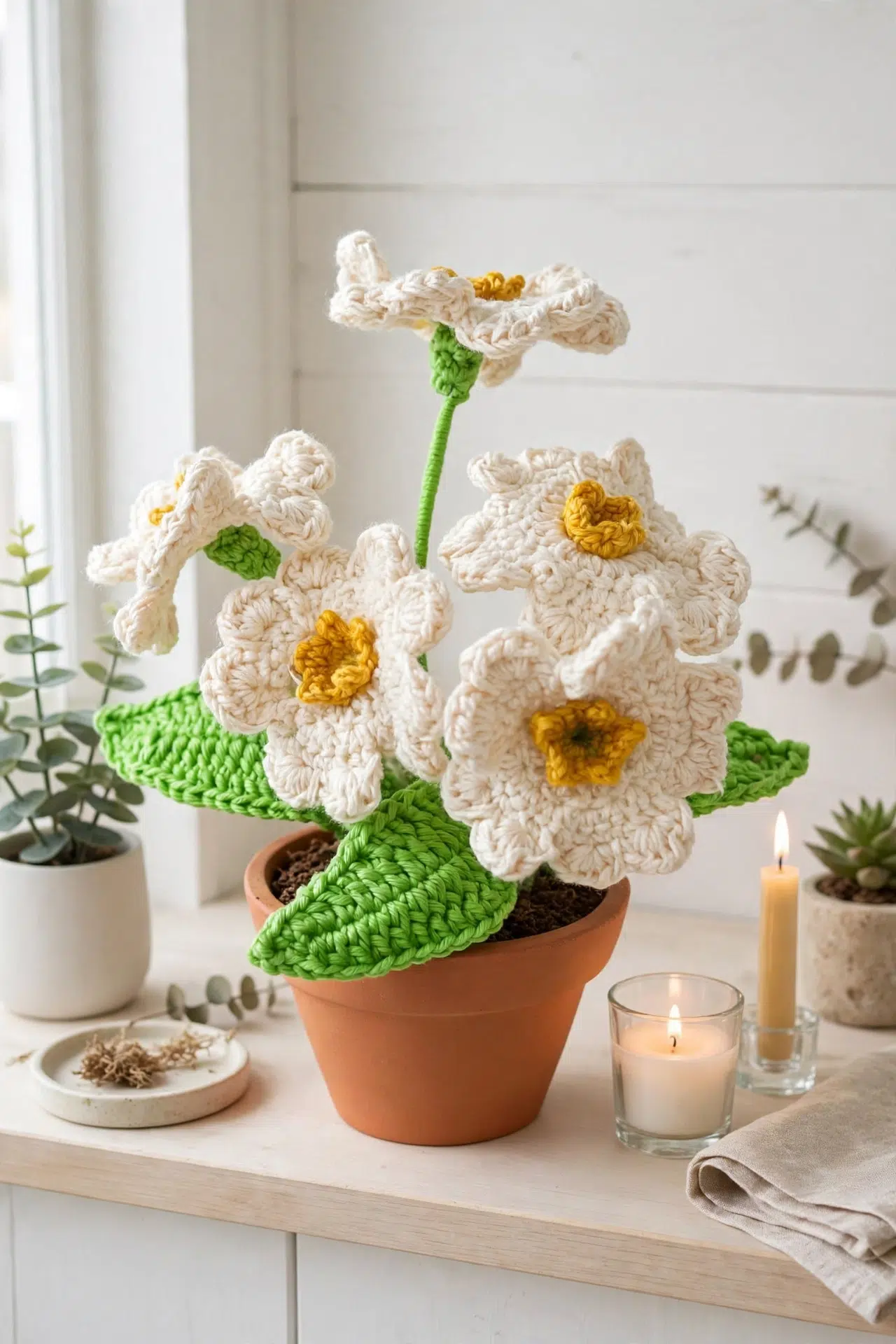
There's twice the satisfaction in making a Crochet Primrose Flower: the stitching is enjoyable, and the finished stem has plenty to do afterward. Set a cluster in a small kitchen vase, keep one beside your desk, or use a single flower to add a handmade detail to a wrapped gift.

Your hands get a pleasing mix of compact sc rounds, dc increases, a ring of picots, and short turned petals. Each stage changes before it can feel repetitive, while the five-petal rhythm makes the flower easy to settle into.
Jump to:
- Why I Make These on Repeat
- Pattern Details
- Materials You'll Need
- Stitches & Abbreviations
- How to Crochet the Primrose Flower
- Tips for Success
- Ways to Adapt Your Crochet Primrose
- Fixing Petal and Center Problems
- Handmade Flowers for Everyday Spaces
- Care Instructions
- More Crochet Flower Patterns
- Frequently Asked Questions
Why I Make These on Repeat
- A satisfying small project: One flower takes about 45-90 minutes, so you can finish a complete stem without committing to long rows or complicated shaping.
- A practical stash project: Each flower uses short lengths of sport-weight yarn in three colors. Fine thread held double also works, which gives those smaller leftovers a useful job.
- An easy bouquet to build: Every stem is made separately. You can stop after one or continue until you have the 4-6 flowers needed for a small arrangement.
- Simple size changes: The same instructions work with other yarn weights. Your yarn and hook choice control the finished diameter, so there's no separate resizing calculation.
Pattern Details
- Skill Level: Easy
- Finished Size: 5 cm diameter when made with a 1.75 mm hook
- Yarn Weight: Sport weight
- Time to Make: about 45-90 minutes per flower
Materials You'll Need
Gather three small yarn amounts, a snug hook, and the stem supplies before you begin so you can move straight from crocheting to assembly.
- 10-15 meters sport weight yarn in cream or chosen flower color; the sample uses vintage thread held double in ecru
- 3 meters sport weight yarn in green; the sample uses Circulo Clea Thread held double in Apples green
- 2 meters sport weight yarn in yellow; the sample uses Botanical Yarns Sock mini
- Matching crochet hook for the chosen yarn; the sample uses a 1.75 mm | US 6 crochet hook: Choose the smallest hook that works comfortably with your yarn. Tight stitches give the center and petals more structure.
- Scissors
- Tapestry needle
- 20 cm piece of florist wire
- Pliers: The wire forms the stem and should be folded at the tips before the final wrapping. Use the pliers carefully so the finished end is smooth.
Stitches & Abbreviations
- ch - chain
- sl st - slip stitch
- sc - single crochet
- hdc - half double crochet
- dc - double crochet
- flo - front loop only
- blo - back loop only
inc: Work 2 of the indicated stitches in the same stitch.
picot: Ch 3, then sl st into the third ch from the hook.
How to Crochet the Primrose Flower
Work the compact flower center first, build five petals around it, and finish by adding the wrapped wire stem.
The flower is made in the round, with both front and back loops used. The petals are turned, then joined to the base with sl st. Rows 1-4 continue in the round. A wire is threaded through the flower base, then wrapped with green yarn to form the stem. Use the smallest suitable hook for the chosen yarn to create tight stitches that help the flower keep its form. This pattern includes flowers only.
Flower
- Row 1: With green yarn, make a magic circle. Ch 1 as a heightening chain, then work 5 sc into the center of the magic circle. Continue in the round. (5)
- Rows 2-4: Work 5 sc in each row. Fasten off and weave in the ends. (5)
- Row 5: With yellow yarn, join in any stitch. Work an sc inc in each of the 5 stitches. (10)
- Row 6: Working in flo only, *sc, picot, sc; rep from * 4 more times. Sl st into the first sc. Fasten off and weave in the ends.
- Row 7: With cream yarn, join in the blo of the first stitch from Row 5. Ch 3, which counts as a dc, and dc in the same stitch. Dc in the next stitch, *dc inc in the next stitch, dc in the next stitch; rep from * 3 more times. Sl st into the first stitch. (15)
Petals
- Row 8, Step 1: Work an sc inc in each of the next 3 stitches. Turn. (6)
- Row 8, Step 2: Work 6 sc. Turn. (6)
- Row 8, Step 3: Skip a stitch, work 5 hdc into the same stitch, skip a stitch, then sl st into the space between the third and fourth sc from Row 8, Step 1.
- Row 8, Step 4: Skip a stitch, work 5 hdc into the same stitch, then sl st into the final sc. Turn to work 3 sl st down the side of the petal. The first petal is complete.
- Row 8, Repeat Steps 1-4: Repeat Steps 1-4 4 more times. Sl st into the first sc. Fasten off and weave in the ends.
Assembly
- Step 1: Bend the florist wire in half. Thread it through the center of the flower, weaving the wire in and out of the first 3 rows to secure it.
- Step 2: Thread a 2 meter piece of green yarn through the base of the flower and carefully wrap the yarn around the folded wire. Fold the wire tips up against the stem, then continue wrapping the yarn around all the wires to create a smooth tip. Once you reach the end, fasten off and weave in the ends.
Yarn and sizing options
The flower can be made with nearly any yarn and a matching hook. Use the smallest suitable hook for tight stitches. Thicker yarn creates a larger flower, while finer yarn creates a smaller flower.
Bouquet size
Make 4-6 flowers for a small bouquet. The sample arrangement contains 5 flowers.
Color options
The flower yarn can be neutral or vibrant, including pinks, pastels, and bold purples.
Tips for Success
- Mark the beginning: Place a removable marker in the first stitch while working Rows 1-4 continuously. Those rounds contain only 5 stitches, so the beginning can be easy to pass.
- Protect the back loops: Row 6 is worked in the front loops of Row 5. Keep the back loops untouched because Row 7 joins directly into them.
- Count the petal bases: Row 7 ends with 15 dc, and each petal begins across 3 stitches. Five complete groups of 3 keep the petals evenly allocated.
- Finish the wire safely: Fold both wire tips upward against the stem before wrapping the final section. Cover the folded area closely with yarn so no sharp end is exposed.
Ways to Adapt Your Crochet Primrose
- Change the yarn weight: You can use nearly any yarn with a matching small hook. A thicker strand produces a larger flower and stem covering, while finer yarn makes the entire project smaller.
- Hold thread double: Fine crochet thread can be held double to approximate the sport-weight fabric used here. Keep both strands together in every stitch so the surface remains consistent.
- Adjust the flower colors: Use a neutral flower yarn or choose vibrant pinks, pastels, or bold purples. Changing color doesn't alter the stitch counts or construction.
- Build a different cluster: One stem works alone, while 4-6 flowers make a small bouquet. Five stems give you the same cluster size used for the sample arrangement.
- Make a flower without a stem: You may stop before assembly if you need a flat embellishment. The flower will be complete, but it won't stand in a vase without the folded wire and wrapped yarn stem.
Fixing Petal and Center Problems
- The final petal won't fit: Check Row 7 for all 15 dc. Each petal uses the next 3 base stitches, so a missing dc or an extra stitch used by an earlier petal shifts the final repeat.
- There are no back loops left: Row 6 was likely worked through both loops. That round must use flo only so the blo of Row 5 remain available for joining the cream yarn in Row 7.
- The flower feels floppy: Move to a smaller suitable hook and keep the stitches firm. Loose stitches reduce the structure of the center and petals, especially when the flower is attached to its wire stem.
Handmade Flowers for Everyday Spaces
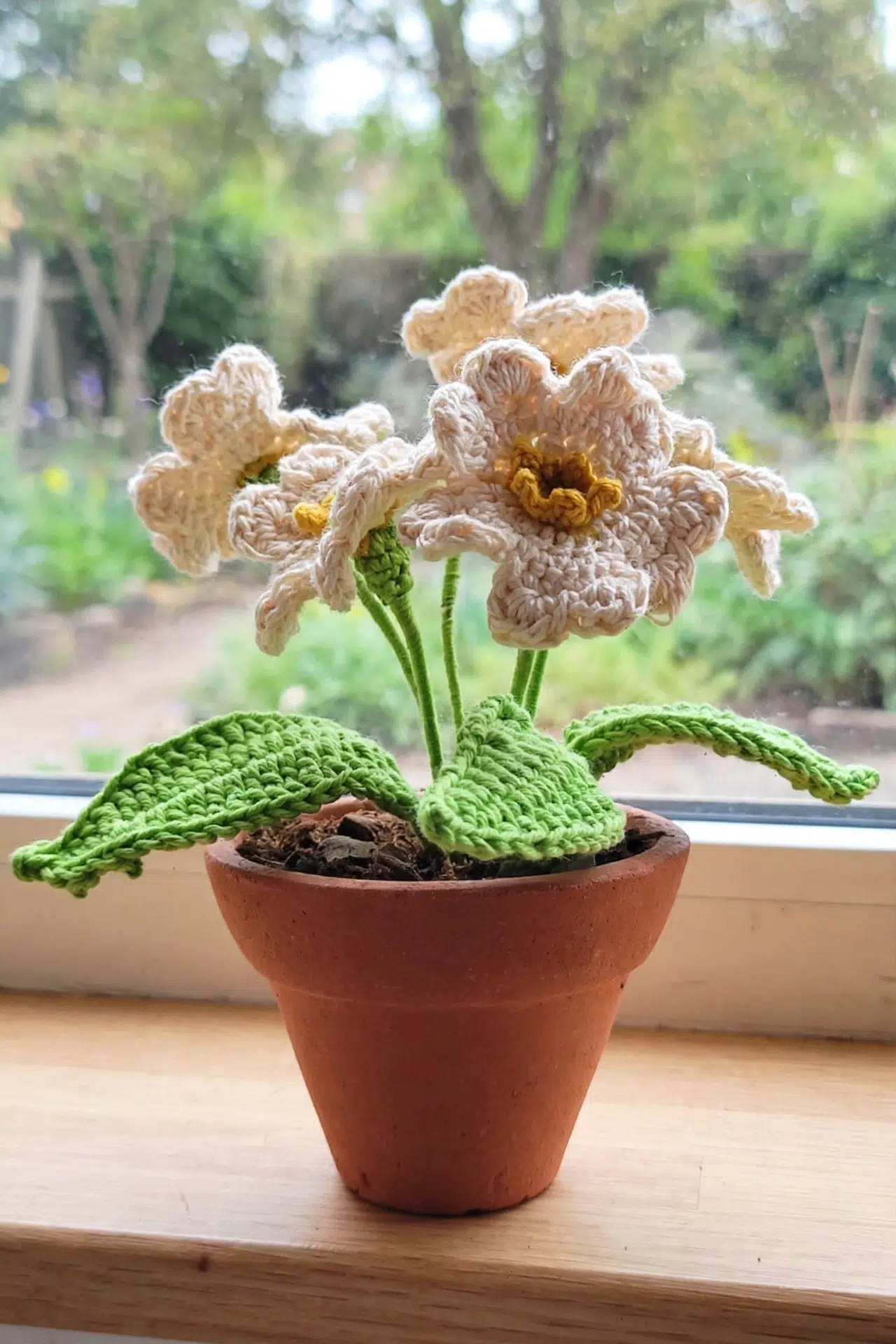
Gather 4-6 finished stems in a small vase for a kitchen counter, desk, shelf, or bedside table. A single stem also fits neatly into a narrow bud vase and gives you an arrangement that doesn't need water.
Care Instructions
Because the yarn fiber isn't specified and the flower contains wire, spot clean it gently rather than machine washing or soaking it. Blot away moisture and let the flower air dry fully. Reshape the petals with your fingers if needed, taking care not to bend the wrapped stem sharply.
More Crochet Flower Patterns
- Delicate Crochet Aster Flower
- Wire-Stem Crochet Daisy
- Purple Crochet Thistle Flower
- Realistic Crochet Daffodils
- Natural Crochet Roses
Frequently Asked Questions
How many petals does one flower have?
One flower has 5 petals. Row 7 creates 15 dc, and each petal begins by increasing across the next 3 stitches. Repeating the four petal steps 4 more times after the first petal uses all five groups and brings you back to the beginning.
Why is Row 6 worked in the front loops only?
The untouched back loops are needed for Row 7. Working the yellow sc and picots in flo leaves a clear line of blo from Row 5 where the cream yarn can be joined. If you crochet through both loops, you'll lose that intended attachment point.
Can I use a yarn other than sport weight?
Yes, nearly any yarn can be used with a matching small hook. The stitch counts stay the same, but the flower's diameter and the thickness of the wrapped stem will change. Choose the smallest hook you can handle comfortably so the stitches remain firm.
How many flowers should I make for a bouquet?
Plan on 4-6 flowers for a small bouquet. The sample cluster uses 5, which sits in the middle of that range. Since each flower and stem is completed separately, you can arrange them as you work and stop when your vase feels comfortably filled.
When should I add the florist wire?
Add the wire only after the flower is crocheted and its yarn ends are woven in. Folding and threading it through the first 3 rows secures the stem at the center. The green wrapping then covers the doubled wire and its folded tips in one continuous finish.
Crochet Primrose Flower is one of those compact, satisfying projects I expect you'll return to whenever your yarn basket offers a few useful leftovers. Tell me in the comments how many stems you're making.