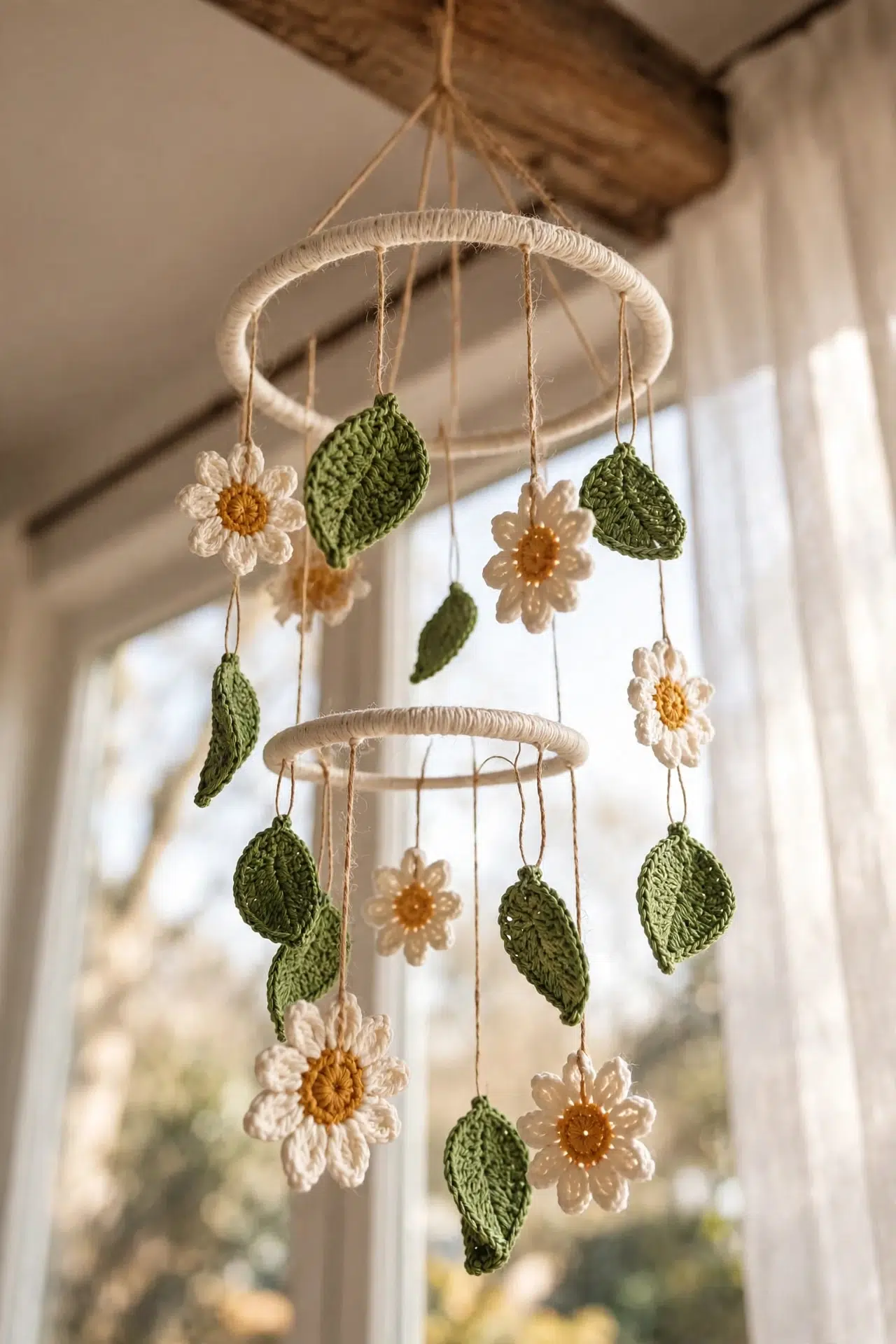
I've been on a serious boho home decor kick lately, and this one really does scratch that itch in the best way. The Boho Daisy Leaf Mobile Crochet Pattern is one of those projects that feels a little special the moment it comes together. It's an easy make, but the finished result looks like something you'd find in a boutique shop and absolutely would not expect to have crocheted yourself on a Tuesday evening.

Jump to:
About This Project
What I love about this one is how satisfying the construction actually is. You're working with two rings at different scales, layering crocheted leaves and daisy motifs across them, and the way it all comes together into a hanging mobile is genuinely fun to assemble. It's the kind of project where each small piece feels almost too simple on its own, and then you put it all together and suddenly it looks like a whole thing.
I'd make this for a nursery, a boho living room corner, or honestly as a gift for anyone who has that kind of earthy, natural aesthetic going on in their home. It suits a new baby gift really well, but it's not baby-specific at all. I'd hang this in my own bedroom without a second thought.
What Makes This Pattern Special
A genuinely easy pattern that produces a finished piece that looks far more complex than it is.
- Skill Level: Rated easy, so newer crocheters can tackle this with no trouble at all.
- Gifting Potential: Makes a beautiful, personal handmade gift for baby showers, housewarmings, or anyone with a boho-leaning home.
- Technique Value: A great intro to working motifs in the round and assembling a multi-piece hanging project.
- Impressive Finish: The dual-ring structure gives it a layered, intentional look that feels well above its actual difficulty level.
- Versatile Sizing: The finished mobile has a generous hang length, so it works as a real statement piece rather than something tiny and easy to overlook.
Materials You'll Need
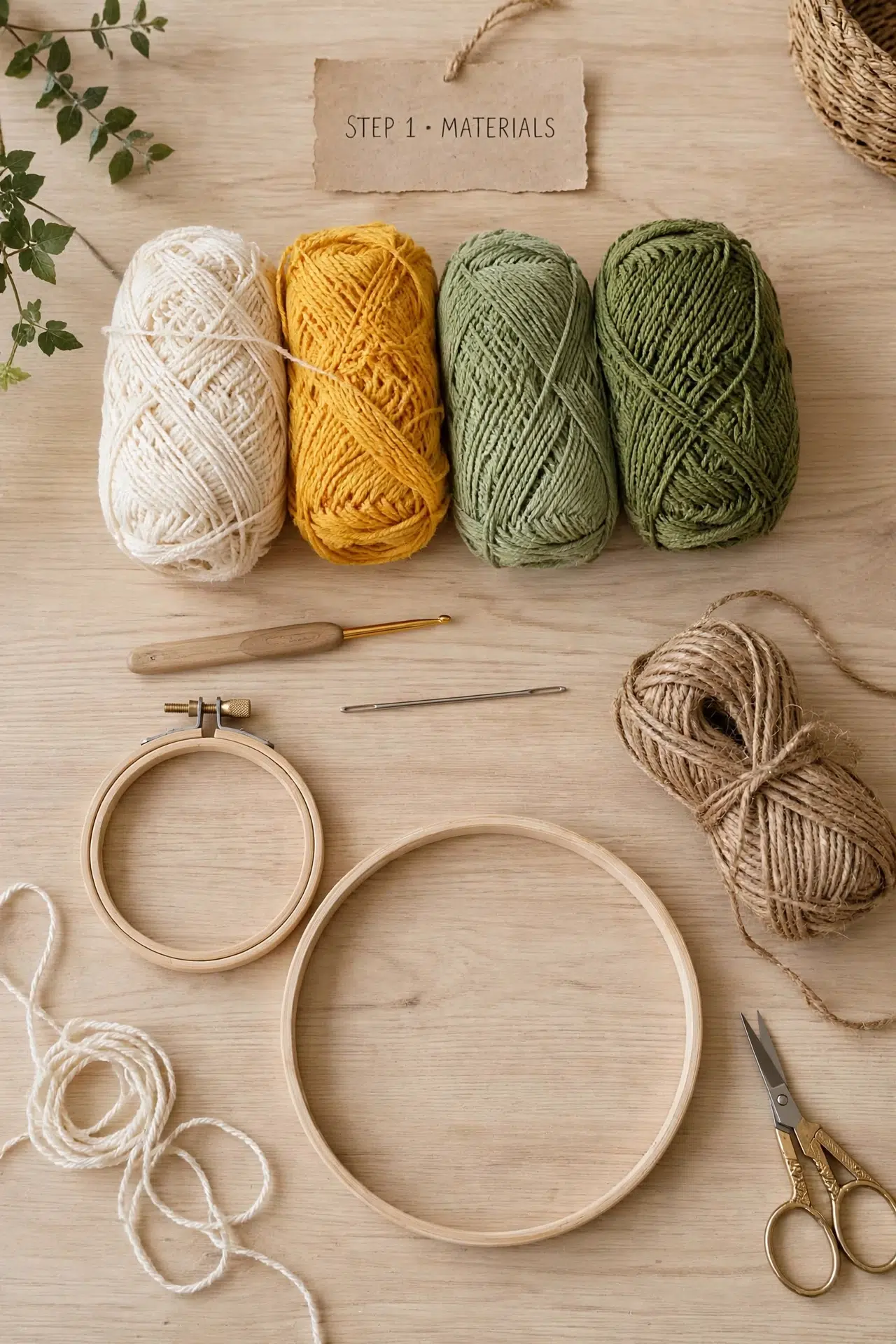
This is a great excuse to raid your DK scraps — you really only need small amounts of four colors.
- DK Weight Cotton Yarn: Cotton is the right call here because it holds its shape well and doesn't stretch out once the pieces are hanging. A DK or sport weight cotton gives you enough stitch definition to see the petals and leaf edges clearly, without the finished pieces looking lumpy or soft. You'll need small amounts of four colors: cream or off-white (Color A) for the daisy petals and ring wrapping, soft yellow (Color B) for the daisy centers, sage green (Color C) for the smooth leaves, and a darker moss green (Color D) for the lobed oak-style leaves. None of these need much yardage at all — we're talking scraps, really, so this is a good project for leftovers.
- 3.5mm (US E/4) Crochet Hook: This size pairs well with DK cotton and keeps the fabric tight enough that the pieces have a clean, structured look rather than anything floppy.
- Two embroidery hoops: One approx. 12cm/4.75in and one approx. 18cm/7in, wooden or metal both work. The rings aren't just structural — you'll be crocheting directly around them with single crochet, so the surface texture matters a little. Smooth metal rings are easy to work around; wooden ones have a bit more grip if you find the yarn sliding.
- Jute twine or cotton cord: About 6–8 meters (20–26 feet) total. This is used for the hanging cords and the suspension lines that connect everything, so don't skimp on it. Jute gives the mobile a more natural, earthy look; cotton cord keeps things cleaner and more modern. Either works fine.
- Also needed: yarn needle, scissors
Color Sequence & Yarn Changes
There's no color work happening within individual pieces — each daisy, leaf, and ring section is worked in a single color from start to finish. The colors come into play when you're choosing which pieces go where on the mobile, so it's worth laying everything out before you start attaching anything to the rings.
At a Glance
A few daisies and leaves hung from two wrapped hoops — this mobile is a pretty low-key make once you get the hanging lengths sorted.
| Skill Level | Easy |
| Pattern Gauge | Gauge is not critical for this project. Consistency between matching components matters more than exact measurement. |
| Finished Size | Finished mobile hangs approx. 55–65cm/22–26in from the suspension point to the lowest leaf tip. Ring diameters: approx. 12cm/4.75in and 18cm/7in. |
| Yarn Weight | 3 Light / DK |
| Fiber | Cotton |
| Terminology | US |
Stitches & Abbreviations
Nothing unusual here — all standard stitches you've probably used a hundred times.
- ch = chain
- sc = single crochet
- hdc = half double crochet
- dc = double crochet
- sl st = slip stitch
- MR = magic ring
- st(s) = stitch(es)
- rnd(s) = round(s)
- rep = repeat
The Critical Details
This pattern is written in US terminology throughout. The two hoops are covered by working sc directly around the physical hoop — not over a foundation chain. It's a different feel than wrapping yarn, but it sits neatly and holds well on cotton.
The daisies are worked in rounds. The leaves are worked in rows. They're separate pieces, finished individually before being assembled onto the rings. Gauge doesn't need to be exact, but if you're making multiples of the same element — several leaves for the same strand, for instance — keep your tension consistent across those so they hang evenly.
Crochet Instructions
Here's how I make each piece of this boho daisy leaf mobile crochet pattern, from the wrapped rings to the last little leaf.
Wrapped Rings (Make 2: One Small, One Large)
These two rings are the backbone of the whole mobile. You're crocheting directly around the hoop material itself, not into a foundation chain, so the stitches grip the ring rather than sitting on top of it. The small ring will need roughly 55–65 sc to cover fully, and the large ring roughly 85–95 sc; exact numbers vary by ring thickness.
Step 1: Join Color A with a slip knot directly around the ring.
Step 2: Work sc evenly around the entire ring (work directly around the hoop material itself), packing stitches closely so no bare ring shows through. Keep your tension firm here. If the stitches are loose, the hoop will peek through and the coverage won't hold.
Step 3: Continue until you return to the starting point. Sl st to the first sc to join. Fasten off and weave in ends.
Daisies (Make 8)
These little flowers come together in just two rounds, each worked in a different color. The center is Color B, and the petals are worked in Color A directly into those center stitches.
Round 1 (Color B): MR, 6 sc in ring, sl st to first sc to join. [6 sc] Fasten off, leaving a short tail.
Round 2 (Join Color A into any Round 1 st): Ch 1, *(sc, hdc, dc, hdc, sc) in next st; rep from * around. [30 sts] Sl st to join at the base of the first petal, fasten off leaving a tail for sewing. Each stitch from Round 1 becomes the base of one petal, so you'll end up with 6 petals total. Leave a generous tail — you'll need it to sew these onto the hanging cords later.
Smooth Leaves (Make 8, Color C)
These are worked along a foundation chain and then back down the other side, which gives you a clean, symmetrical leaf shape in a single row. Color C keeps them visually distinct from the lobed leaves.
Step 1: Ch 8.
Row 1: Sc in 2nd ch from hook, sc in next ch, hdc in next 2 ch, dc in next 2 ch, 3 dc in last ch (tip); rotate to work down the other side of the foundation chain: dc in next 2 ch, hdc in next 2 ch, sc in next ch, sc in last ch, sl st to first sc to join. [15 sts] The 3 dc worked into the last chain creates the rounded tip of the leaf. When you rotate and work back down the other side, you're using the unused loops of the original foundation chain.
Step 3: Fasten off, leaving a tail for sewing.
Lobed (Oak-Style) Leaves (Make 8, Color D)
These leaves use a longer foundation chain and a chain-skip technique to create the lobed, indented edges that give them that oak-leaf character. Color D sets them apart from the smooth leaves on the finished mobile.
Step 1: Ch 11.
Row 1: Sc in 2nd ch from hook, *ch 2, skip next ch, sc in next ch; rep from * across to the last ch, 3 sc in last ch (tip); rotate to work down the other side of the foundation chain: *ch 2, skip next ch, sc in next ch; rep from * across, sl st to first sc to join. The ch-2 spaces skipped along each side are what create the lobed indentations. Make sure you're skipping the correct chains as you go — it's easy to lose your place on a longer foundation chain, so count carefully on the first pass.
Step 3: Fasten off, leaving a tail for sewing.
Hanging Cords
No crochet here — just cutting your jute twine or cotton cord to length before assembly. I cut a few extra pieces just in case, since it's easier to trim than to splice.
Step 1: Cut jute twine or cotton cord into the following lengths (adjust to taste):
Step 2: Cut 3 cords, approx. 40cm/16in each (connect small ring to large ring).
Step 3: Cut 3 cords, approx. 45cm/18in each (gather from the small ring up to a central suspension point).
Step 4: Cut 8–10 cords, varying from 20cm/8in to 45cm/18in (hang from the large ring downward, holding the daisies and leaves). Varying the lengths of these lower cords is what gives the mobile its layered, cascading look, so don't cut them all the same.
Putting It All Together
With all the pieces made and cords cut, it's time to assemble the mobile. I lay both wrapped rings flat first so I can see the spacing before I commit to any knots.
Step 1: Lay both wrapped rings flat, with the small ring centered above where the large ring will sit.
Step 2: Tie one end of each of the 3 shorter connecting cords to the small ring, evenly spaced around it; tie the other end to the large ring at matching evenly spaced points. Even spacing here matters for balance — I eyeball thirds around each ring and mark the points lightly before tying.
Step 3: Tie the 3 longer cords to the small ring at the same 3 points, then gather all 3 upper ends together and knot securely to form the hanging loop.
Step 4: Tie the 8–10 remaining hanging cords to the large ring at varied points around its circumference, letting the lengths differ.
Step 5: Working down each hanging cord, sew or tightly knot on a mix of leaves and daisies at varied intervals (2–4 components per cord), with a single leaf at the very bottom tip of each strand. I use the yarn tails left on each daisy and leaf to sew them directly onto the cord — it keeps everything secure without adding extra knots.
Step 6: Hang the mobile to check balance; adjust cords by re-tying at a slightly different point on the ring as needed. Don't skip this step. It's much easier to correct the balance now than after you've trimmed everything.
Step 7: Weave in remaining yarn ends on daisies and leaves, and trim any excess twine at the ring attachment knots.
Care Instructions
Because the crocheted pieces are cotton, they can be hand washed if they get dusty or grimy over time. That said, the jute twine and the wooden or metal rings complicate things. Jute doesn't love water, and wooden hoops can warp if they stay wet. For regular upkeep, a light shake or a pass with a dry cloth is usually all it needs. If you do wash the cotton components, do it before final assembly, or remove them carefully first.
Baby & Child Safety Notes
This mobile is decorative, not a crib mobile. The hanging cords and knotted twine make it unsuitable for use near infants or young children. Keep it well out of reach, displayed as a wall or ceiling accent in a space where small hands can't grab the cords. The lengths of jute twine in particular are a strangulation hazard, so placement really does matter here.
Frequently Asked Questions
Wooden embroidery hoops are what I use, but metal rings work just as well. The sc wrapping covers the ring completely, so the material underneath doesn't really show. The main thing is getting close to the right diameter: roughly 12cm for the small ring and 18cm for the large one. A bit of variation is fine since the cord lengths are adjustable anyway.
There's no fixed stitch count to hit. The small ring takes roughly 55 to 65 sc and the large one around 85 to 95, but those numbers shift depending on how thick your ring is. The goal is just to pack stitches closely enough that no bare ring shows through. Work around and check as you go.
Not really. Consistency between matching pieces matters more than hitting a specific measurement. If your eight daisies are all roughly the same size and your leaves match each other, the mobile will look balanced. The finished hang length has a range of 55 to 65cm precisely because small differences in gauge and cord tension are expected.
The smooth leaves use Color C and are worked from a ch-8 foundation, shaping a simple pointed oval. The lobed oak-style leaves use Color D and start from ch-11, with ch-2 spaces along each side that create that scalloped edge. Using both adds visual variety to the hanging strands. You could make all one type, but the contrast between them is part of what gives the mobile its layered, botanical look.
Re-tie the connecting cords. The three shorter cords that link the small ring to the large ring control the balance, and if one is even slightly longer or positioned off-center, the whole frame tilts. Hang it up after assembly, watch where it pulls, then loosen and shift the cord at that point on the ring. Small adjustments make a big difference.
Yes, scraps are perfect for this. Each color is used in small amounts only: cream for the daisy petals and ring wrapping, soft yellow for the daisy centers, and two greens for the leaves. None of the four colors need more than a partial skein. The bigger yardage consideration is the jute twine or cotton cord, which runs to about 6 to 8 meters total for all the hanging and connecting cords.
Now It's Your Turn!
I'd love to see where you hang yours. A reading nook, a bedroom corner, above a plant shelf: this mobile has a way of making a space feel quieter and more considered somehow. If you make one, tag me on Instagram or drop a photo in the comments. And if you're saving this for later, pinning it to your home decor or crochet projects board on Pinterest is the easiest way to find it again when you're ready to pick up your hook.